
Finding a flight is usually the easy part of becoming location independent.
Finding the right digital nomad accommodation is much harder.
A place can look perfect in photos and become frustrating after three days because the WiFi is unreliable, there is nowhere comfortable to work, the neighbourhood is isolated or you realize that you don’t know a single person in the destination.
Housing is not simply where you sleep when you travel as a digital nomad. It influences your productivity, social life, monthly budget and ultimately how much you enjoy a destination.
For digital nomads in Europe, the options have also expanded enormously. You can choose traditional apartments, monthly rentals, coliving communities, serviced apartments, rural houses and temporary Pop Up Colivings.
The challenge is understanding which type of accommodation actually fits your way of living and working.
This guide explains how to find the best digital nomad accommodation abroad, what you should check before booking and why sometimes paying slightly more for the right environment can create a much better experience.
What Makes Good Digital Nomad Accommodation?
Traditional travellers usually choose accommodation based on three factors: location, price and comfort.
Remote workers need to consider much more.
The first requirement is obvious: reliable internet.
If your income depends on Zoom calls, cloud platforms or online collaboration, WiFi cannot simply be listed as an amenity. It needs to be stable enough for professional work.
The second requirement is somewhere to actually work.
A kitchen chair and a tiny table might be acceptable for checking emails during a holiday. They become much less attractive after eight hours of work.
Good digital nomad accommodation should therefore provide either a proper workspace inside the property or convenient access to a coworking space.
Then come the elements that are easier to overlook before arrival: location, community, kitchen facilities, laundry, noise, transportation and the possibility of staying for several weeks without feeling as though you are living in a hotel room.
The best accommodation combines living, working and experiencing the destination.
The Main Types of Digital Nomad Housing
There is no single housing model that works for every remote worker.
Your ideal option depends on your budget, how long you are staying and how much community you want around you.
Private Apartments
Renting your own apartment provides maximum independence.
You have your own kitchen, bathroom and living environment, and you can create a daily routine without adapting to other residents.
For couples or digital nomads staying several months, this can be particularly attractive.
The disadvantage is social.
Arriving alone in a new destination and renting a private apartment can mean spending your first weeks working alone while simultaneously trying to find coworking spaces, events and people to meet.
Monthly Rentals
Monthly rental platforms have become particularly useful for remote workers.
Airbnb, for example, provides a dedicated monthly-stay search for stays of at least a month and highlights features such as furnished accommodation, kitchens, WiFi and dedicated workspaces.
You can explore Airbnb’s monthly stays when comparing longer-term accommodation.
This model offers flexibility, but remember to check the final monthly price, including platform fees, cleaning and additional expenses.
Coliving
Coliving takes a different approach.
Instead of solving accommodation, work and social life separately, you enter an environment designed around shared living and community.
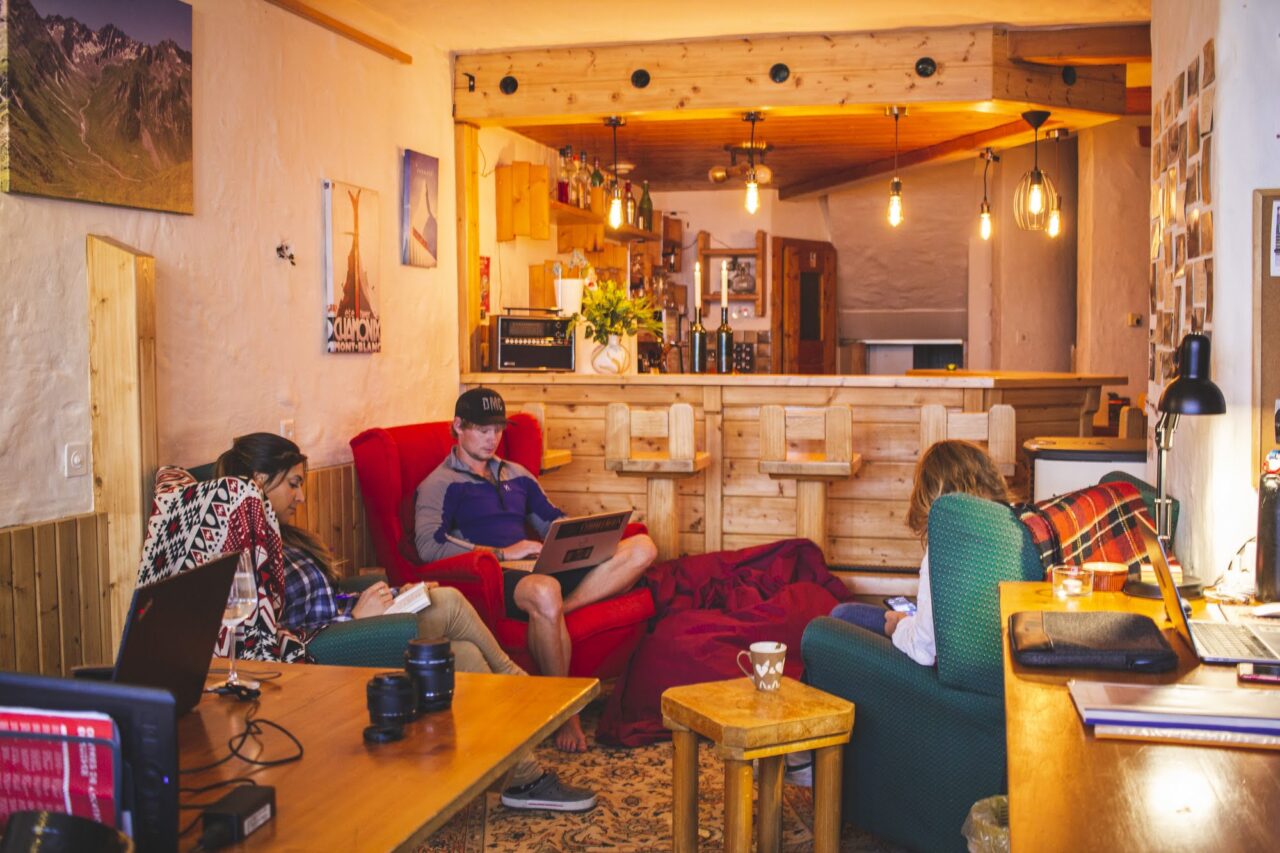
A typical coliving may include a private bedroom, shared kitchen and living spaces, coworking facilities, fast internet and community activities.
If you are unfamiliar with the model, we have explained it in detail in our guide to what coliving is for Digital Nomads.
For someone travelling alone, the biggest benefit is often not the building itself.
It is arriving somewhere where a community already exists.
Why Coliving Has Become Popular With Digital Nomads in Europe
The growth of remote work has created a strange situation.
Millions of professionals can now work from almost anywhere, but moving somewhere new can still be socially difficult.
This is one reason coliving has grown among digital nomads in Europe.
Platforms such as Coliving.com currently list thousands of furnished rooms and coliving homes across hundreds of destinations, including numerous options throughout Europe.
You can browse Coliving.com accommodation for digital nomads in Europe to compare different community-based housing options.
Coliving can remove several problems at once: accommodation, workspace, utilities and social connection.
But not every coliving provides the same experience.
Some are essentially serviced apartments with shared common areas.
Others are highly social communities with Community Managers, weekly activities and residents who actively spend time together.
Before booking, understand which one you are choosing.
How Long Are You Staying?
Duration should influence your accommodation strategy.
Less Than One Week
For very short stays, convenience usually matters more than community.
Hotels, apartments and short-term rentals work well because you probably don’t have enough time to fully integrate into a coliving environment.
Two to Four Weeks
This is where community-based accommodation becomes particularly interesting.
Three or four weeks gives you enough time to establish a routine, meet other residents and experience a destination beyond its tourist attractions.
It is also the duration we often prefer for our own communities.
One to Three Months
For longer stays, price becomes increasingly important.
Monthly discounts, cooking facilities, laundry and comfortable workspaces can save significant amounts of money.
At this stage, investigate whether the destination works for everyday life rather than simply whether it looks attractive.
Three Months or More
Long-term digital nomads might benefit from searching local rental markets rather than relying exclusively on short-term platforms.
However, local leases can involve deposits, contracts and administrative requirements that vary considerably by country.
Start With the Neighbourhood, Not the Apartment
One of the most common mistakes when choosing digital nomad accommodation is falling in love with the property before researching where it is located.
A beautiful apartment 40 minutes from everything can quickly become inconvenient.
Before booking, check how far you are from supermarkets, cafés, restaurants, coworking spaces and public transportation.
Consider what your normal working day will actually look like.
Can you walk somewhere for coffee in the morning?
Can you go out for dinner without organizing transportation?
Can you meet other people without travelling across the entire city?
For remote workers, a slightly smaller apartment in a well-connected neighbourhood can provide a much better experience than a larger property on the outskirts.
Check the Internet Before You Book
Never assume that “WiFi included” means “suitable for remote work.”
Ask the host for actual internet speed if your job requires a stable connection.
Download speed matters, but upload speed and stability can be equally important if you spend hours in video meetings.
Also investigate backup options. Is there strong 4G or 5G coverage? Is there a coworking space nearby?
For professionals working remotely, connectivity should be considered part of the accommodation infrastructure rather than an optional amenity.
Look Carefully at the Workspace
Accommodation photos often show beautiful bedrooms, terraces and swimming pools.
The desk receives much less attention.
Yet if you work eight hours per day, that desk might be the most important piece of furniture in the property.
Look for an actual chair, sufficiently large desk and appropriate lighting.
If you take regular calls, consider privacy and background noise too.
In a coliving, ask whether there are dedicated call rooms or quiet areas.
In an apartment, consider whether you will genuinely be comfortable working there for several weeks.
Calculate the Real Monthly Cost
Never compare accommodation only by headline price.
Imagine an apartment costing €700 per month and a coliving costing €950.
Initially, the apartment looks significantly cheaper.
But then you add utilities, internet, coworking membership, cleaning, transportation and activities.
The difference might become considerably smaller.
The correct calculation for digital nomad accommodation is:
Accommodation + utilities + workspace + transportation + additional fees + social activities.
This becomes particularly important in expensive European destinations.
If budget is one of your priorities, our guide to finding Affordable Coliving in Italy compares big-city living with more accessible destinations in Southern Italy.
Don’t Underestimate Community
Accommodation can be technically perfect and still produce a disappointing experience.
You have fast WiFi. You have an excellent apartment. You have a comfortable desk.
But every evening, you are alone.
For people travelling independently, social environment deserves to be considered alongside price and location.
Ask yourself what type of experience you want.
Some remote workers prefer complete independence and actively build their own social networks.
Others prefer arriving somewhere where introductions, dinners and activities happen naturally.
This is why community is increasingly becoming part of the housing decision for digital nomads in Europe.
Community Management Can Change the Entire Experience
A Community Manager is one of the biggest differences between simply sharing accommodation and joining a real coliving community.
Their job is not to create mandatory entertainment.
A good Community Manager helps new residents meet each other, organizes activities, communicates local information and creates opportunities for connection without forcing participation.
This is particularly valuable during the first days.
Arriving alone in another country can be intimidating. Having someone introduce you to the community immediately removes much of that friction.
When comparing coliving options, ask whether the community is actively managed.
Coliving in Italy: Big Cities vs Smaller Destinations
Italy illustrates how different the digital nomad housing experience can become depending on location.
Milan, Rome and Florence offer large international communities and excellent professional infrastructure, but accommodation can represent a significant part of your monthly budget.
Cities such as Bologna, Turin, Bari, Naples and Palermo can provide different balances between infrastructure and affordability.
Then there is another Italy.
Small towns and rural destinations increasingly provide remote workers with an alternative based on slower living, lower housing costs and deeper interaction with local communities.
If you are comparing possible destinations, our guide to the best cities in Italy for Digital Nomads explores both major cities and destinations in Southern Italy.
Why We Believe Coliving in Italy Can Be More Than One Building
At Tursi Digital Nomads, we have experimented with a different housing model.
Instead of placing everyone inside one purpose-built coliving property, our communities can use different apartments and houses around the destination while bringing everyone together through a central coworking space and shared programme.
In Tursi, for example, participants can live in properties distributed through the town and work together from a coworking space inside a former monastery.
The result is a distributed coliving.
Rather than separating remote workers from the destination, the town itself becomes part of their living environment.
You walk through the same streets as local residents, visit neighbourhood businesses and gradually become familiar with everyday village life.
For us, that interaction is an important part of coliving in Italy.
Tursi and Basilicata: Housing Inside a Real Italian Village
Tursi offers a very different proposition from conventional digital nomad destinations.
There are no enormous coliving campuses or neighbourhoods dominated by remote workers.
Instead, accommodation is integrated into a small Southern Italian town.
This creates several advantages.
Properties that might otherwise remain underused can receive new residents. Participants have access to more authentic housing than a standardized tourism complex. And spending is distributed across local landlords and businesses.
The lower cost of living in Basilicata can also make longer stays more sustainable compared with Italy’s largest cities.
For remote workers interested in coliving in Italy but looking beyond Milan, Rome or Florence, small towns can therefore provide both affordability and a more immersive cultural experience.
What to Ask Before Booking Digital Nomad Accommodation
Before paying, you should be able to answer a few essential questions.
How fast is the internet? Where will you work? What exactly is included in the price? Are utilities included?
Is there heating or air conditioning appropriate for the season?
How far is the accommodation from supermarkets and restaurants? Can you live there without a car?
Is there somewhere to take private calls? Who else will be staying there?
Is there a Community Manager? Are activities included or paid separately?
What is the cancellation policy?
For longer stays, also check laundry facilities, kitchen equipment and how frequently the accommodation is cleaned.
Five minutes of research before booking can prevent weeks of frustration.
Red Flags When Booking Accommodation Abroad
Certain warning signs deserve attention.
The first is vague information about internet quality.
The second is a property marketed heavily toward remote workers without showing any real workspace.
Another is unclear pricing.
If accommodation appears unusually cheap, check cleaning charges, deposits, utilities and platform fees before comparing it with other options.
For colivings, be cautious when the word “community” is used extensively but there is little evidence of actual community life.
Look at recent photos, activities, reviews and social media.
You should be able to see people actually living the experience.
Should You Book Everything Before Arriving?
Not necessarily.
For longer stays, some digital nomads prefer booking temporary accommodation for the first few days and inspecting long-term options locally.
This can work particularly well in destinations with active local rental markets.
However, it creates uncertainty and takes time.
If you are joining a structured community or travelling during peak season, booking beforehand is usually safer.
Your strategy should depend on availability, destination and your tolerance for uncertainty.
The Cheapest Accommodation Isn’t Always the Best Value
Remote work changes how accommodation should be evaluated.
You are not booking somewhere to sleep between sightseeing activities.
You may spend eight hours every weekday inside or around that property.
Saving €150 per month is not necessarily worthwhile if it means working from an uncomfortable chair, commuting daily to a coworking space or feeling isolated.
For digital nomads in Europe, good housing should help you maintain productivity while giving you access to the lifestyle you travelled for in the first place.
Price matters.
But value matters more.
Digital Nomad Housing Should Help You Live Somewhere, Not Just Stay Somewhere
The best digital nomad accommodation does more than provide a bed.
It gives you the infrastructure to work, enough comfort to develop a routine and access to the destination around you.
For some people, that means a private apartment in Lisbon, Rome or Athens.
For others, it means joining a large international coliving.
And for remote workers looking for something more local, coliving in Italy can also mean living in a small town, working alongside an international community and becoming part of everyday life around you.
The important thing is to stop choosing accommodation as though you were booking a weekend holiday.
When you are staying for several weeks or months, your accommodation becomes part of your lifestyle.
Choose the place that allows you not only to work from abroad, but to actually live there.